Sitars, Ragas and Indian Classical Music
Showing posts with label tuning. Show all posts

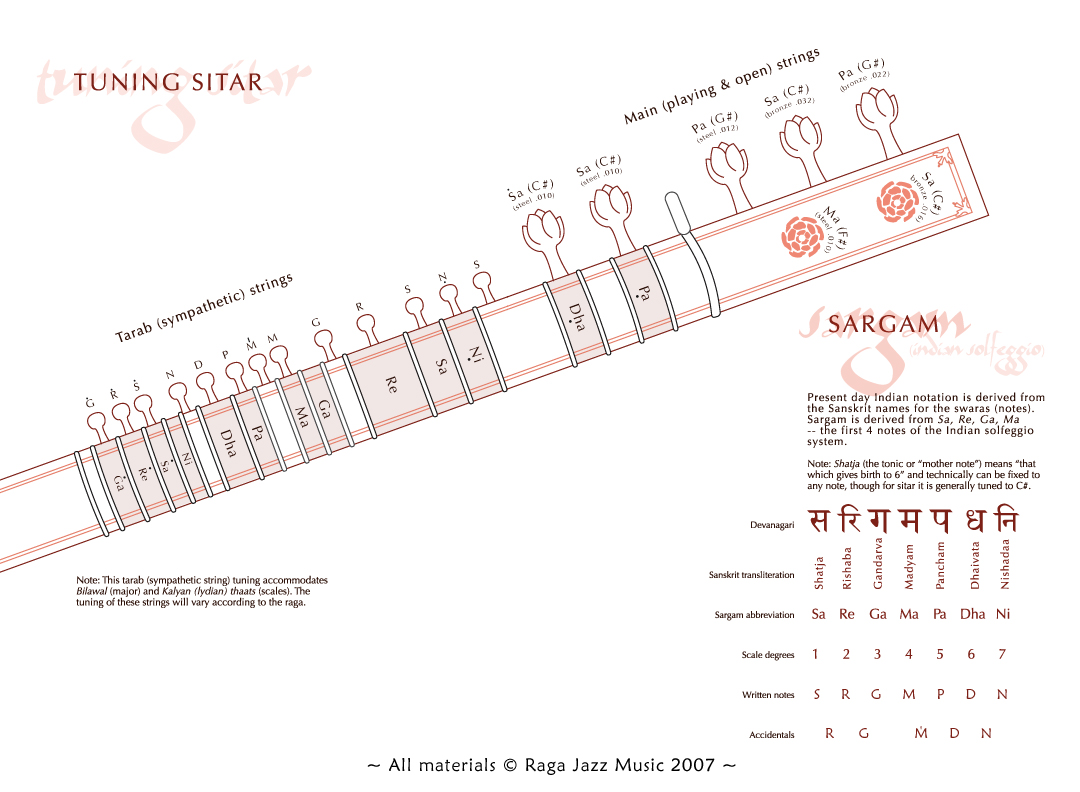
Tips For Sitar (images)

Just a quick post today. I'm posting images that may be useful if you're learning.


Vilayat Khan style tuning

String gauges

Ravi Shankar style tuning


read more "Tips For Sitar (images)"

Tunings For Ragas

I've recently been taking a break from raga yaman and have been tinkering with raga bhimpalasi. I will post a video at the end of the post to give you an idea what this raga sounds like.

However, first I want to list some tunings for various ragas. Tunings for ragas can vary quite a lot depending on which school/style that you follow so the following tunings are just guidelines and changes can certainly be made. I will start with the main playing string (Ma) and work down towards the high pitched strings. You may need to adapt them for your sitar, I use a Gandhar Pancham so it may be different to yours.


(these ragamala paintings don't all correspond to the raga listed)


Raga Yaman

Main Strings
ma, Sa, Ga, Pa, Sa, Sa

Taraf Strings (low to high)
Ni, Sa, Sa, Re, Ga, Ga, Ma, Pa, Pa, Dha, Ni, Sa', Re'


Raga Bhimpalasi

Main Strings
ma, Sa, ma, Pa, Sa, Sa

Taraf Strings (low to high)
ni, Dha, Sa, Sa, Re, ga, ma, Pa, Pa, Dha, ni, Sa', Re'


Raga Bageshri

Main Strings
ma, Sa, ma, Dha, Sa Sa

Taraf Strings (low to high)
ni, Dha, Sa, Sa, Re, ga, ma, ma, Pa, Dha, ni, Sa', Re'


Raga Bhairavi

Main Strings
ma, Sa, ma, Pa, Sa, Sa

Taraf Strings (low to high)
ni, dha, Sa, Sa, re, ga, Ma, Pa, Pa, dha, ni, Sa', re'


Now, here is a wonderful version of raga bhimpalasi by Nikhil Banerjee. This alap is mesmerizing, truly magical. 


read more "Tunings For Ragas"

Restringing A Sitar

Over at Chandrakantha there was recently a discussion about the best way to attach the main top strings to their pegs. Sooner or later you will need to replace a string, whether you snap one or they just get old and dull.

It is quite an easy process to replace the top strings. This photo from Rain City Music shows the best way to attach the string to the peg.


This will give a secure and tight grip on the peg, ensuring that the string does not slip.

At the other end you need to create a little loop to attach to behind the bridge. To do this, wrap the string around your finger (or pencil) so that it creates a 'U' shape, going back in the direction it's coming from. Then turn the small end of the string around the main line and repeat this five or six times. You need to make sure the turns are tight against each other, which can take a bit of practice, in order to create a firm hold.

Once you have done this, attach the loop to the little riser at the bottom of the sitar and start turning the peg, ensuring that the string is running along where it should and crossing the bridge in the correct slot. You may need to pull the string a few times and then re-tighten it as it will take a while for the tension to even out in the various places across the instrument. The string can take a while to become stable and stay in tune because the string can stretch and the tension on the coils on the peg can take a while to even out unless you wind it on with a good even force pulling on the string.

The taraf strings can be a bit fiddly to change as they are tied on to the peg inside the neck, but the principal is pretty much the same. Run the string under the frets and feed it in to the appropriate hole. You should have a little tool to hook the string and pull it out of the peg slot but if you don't then just use what you can, a coat hanger with a little hook bent in to the end should work. Then tie the string on to the peg and push the peg in. Then wind up the string - at this point it might help to pull the string vertically away from the next to create an even tension along the peg when you wind it up.

BuckinghamMusic.com has a great diagram for this:


Try to be patient when replacing strings, it can be very frustrating that they keep going out of tune but if you keep tugging them and then retuning they should stabilize after a day or so.
read more "Restringing A Sitar"

How To Tune A Sitar

There are probably many ways to tune a sitar and every good player will tell you that you should tune by ear, which is certainly something you should work on developing, but this can be difficult when you are starting out. Once you have the sitar tuned properly it should be fairly easy to make small adjustments because you will hear the clashing sound compared to the pureness of a well tuned sitar but if you have never tuned your sitar to Just Intonation this is how we can start, there is quite a lot to do. Don't rush it and don't get frustrated, it sometimes takes a while until you get used to the process.

The Tarafs
So where to start with all those strings? This may not be the 'proper' way to start but it will get your instrument in tune. Start with the taraf strings. These are the sympathetic strings that lay underneath the main set of strings. These are tuned to the raga that you are playing in, the intention is that they ring out on every note you play in the raga. I will be writing out raga yaman so I will show you how to tune to this.


There are a many ways to tune these strings, depending on how many taraf strings you have and which school/branch of tradition you are taught in, amongst other things.

This is the way I tune my sitar, it has 13 taraf strings but some sitars have 11. Going from the longest string to the shortest:

N, D, S, S, R, G, G, m, P, D, N, S, R (remember that the Ma is sharp).

If you have 11 strings you could try this:

N, D, S, S, R, G, m, P, D, N, S

Tune these using Wintemper or whichever Just Intonation tuner you want to use. It may take a while as you might pluck the wrong string, or turn the wrong peg, or you might find that the pegs are fiddly and physically hard to turn. If they are hard to turn just detune it with a slight pulling upward pressure and then tune up again, pushing down when you get near the right note. Try to tune the string exactly to the right frequency, the sitar will sound beautiful if you get it right so take your time and get it perfectly in tune.You may need to go back and check these are still in tune when you have finished because the pressure of tuning one sometimes changes another but do this until it is correct.

The Main Strings
Now for the top strings. Start with the jor string. This is the second string from the bottom as you are looking down on the strings from the playing position. Tune this to Sa. You should hear the taraf strings ringing when you get close to the right tuning but make sure that it is exactly in tune. This is a very important string so make sure you get it accurately in tune. You can use harmonics to check, this is sometimes easier to hear. Touch the string about halfway between the bridge and the nut at the neck, and should be around the 11th fret. Pluck the string while your finger is touching and you should hear a chime sound, you may have to move your finger to find the sweet spot. Check this frequency against the taraf and/or the tuner.

Now the next string. Tune the next thickest string. This should be tuned to Ga. Go through the same steps as the jor string.

The next thickest is tunes to low Sa. The easiest way to do this string is probably to play the jor string and then this thickest string. They need to be tuned to the same note but an octave apart so you should be able to hear the wobble/dissonance if they are not in tune with each other. Make sure you get this low Sa string accurately in tune because it will make everything sound horrible if it's not dead on.

The next string up should be a similar thickness to the taraf strings. This goes to Pa. Again, get this exactly right.

The last two strings tune to Sa, with last one an octave higher than the other.

The string we missed out, the first (bottom) string, needs to go to Ma. Now this is natural Ma, not the sharp version we used for the tarafs. You can use harmonics for this one. Pluck the 11th fret harmonic on the 2nd string and then hit the harmonic on the 7th fret on the first string. Adjust the first string until it sounds pure and completely in tune, no wobble/dissonance.

Now you have your sitar in tune! It would be wise to go back and check all the string again, just to make sure none of them have slipped out of tune while you were doing the others. It should sound beautiful and sing out when you pluck the strings (with your mizrab).

The Frets
The last thing to do is to adjust the frets to make them in tune with the tarafs. This is very important because if you don't then when you play a note it won't ring out and sound beautiful, which is the whole point.

The first thing is to make sure your first (Ma) string is EXACTLY in tune. Check this by plucking the 7th fret harmonic and then plucking the Sa taraf string. When it is exactly in tune pluck the 7th fret harmonic again and then play 7th fret. These two notes should be exactly in tune with each other, just an octave apart. You can play the 7th fret note and pluck the taraf to hear a comparison. Move the fret to make the it exactly right.

Do the same thing on the 17th fret. This is an octave above the 7th.

Now go back to the 8th fret and play the note (first checking the Ma string is in tune again). Pluck the Re taraf to and move the fret until it is exactly in tune with the taraf. You will hear the taraf ring out when it is in the right place.

Now skip a fret and repeat the process with the 10th fret. This is Ga so pluck the Ga taraf and check this. Move the fret to get the Ga taraf to right out.

Skip another fret and go to the 12th fret. This is Ma tivra (sharp). Go through the same process.

The next fret is Pa. Again, the same process.

The next fret is Dha (14th fret). Same process, move the fret until it is exactly in tune with the Dha taraf string.

Skip a fret to the 16th fret and this is Ni. Same process again.

The next fret is high Sa. This should be already in the correct position. The next fret is high Re, and the one after that you can adjust to high Ga.

Go back down to the 1st fret. This is low Ma tivra. The 2nd fret is Pa. The 4th fret is Dha and the 6th is Ni. These last two should be checked against the first two (longest) taraf strings.

All of these frets listed should make the taraf string ring out when you pluck them. The important thing when doing this fret adjustment process is to make sure the Ma string is exactly in tune before you go to the next fret.

Now you're finished, your sitar is in tune according to Just Intonation and raga yaman is ready to play! It should sound beautiful now.
read more "How To Tune A Sitar"

Indian Tuning - Just Intonation

When it comes to sitars you really don't want to be using a guitar tuner. Sitars, and a lot of Indian instruments, use something called Just Intonation, which is a method of tuning quite different from that of a guitar or a piano.

Just Intonation notes are written as fractions or ratios corresponding to the base note. This means that the resulting notes are purer sounding compared to the rounded up/down version that western music creates.

Have you ever noticed the 'beating' or slight clashing/dissonant sound when you play a complex (or even a simple) chord on a piano or a guitar? This is because the intervals between the pitches are not pure or mathematically correct. The dissonance does add a certain flavour in itself but for Indian music this isn't what we are looking for.

I'm not going to go in to this too far because it is a very deep subject and is not really relevant, but just remember that there is a difference. In western terms, think how a harp sounds almost heavenly and compare that to a piano.

So how do you tune an instrument in Just Intonation? It's actually surprisingly easy to do it by ear because Just Intonation is how we instinctively think two notes should relate together. However, maybe you don't know what you are listening for yet.


The best way to start is probably with a tuner. I don't mean a guitar tuner here (unless it is an advanced one and can do Just Intonation). There are loads of freeware/open source tuners available to download. I used Wintemper for a while, which you can download for free from here - http://wintemper.com/. There is also one called Chromatica which, although isn't free, you can use the evaluation version. This is a bit more flexible to use than Wintemper.

Once you have installed Wintemper, select Just Intonation No.1 from the drop down list on the left. Now you can click on the notes and you should hear the tones in Just Intonation.

I have to say something now though - there are many different types of Just Intonation and not one single standard tuning. The one in Wintemper is good but after a while I noticed that on the sitar the Dha didn't sound quite right.

You can tune this difference quite easily by ear as you should be able to hear that it has a slight beating/dissonance compared to the other notes. The difference is only slight but it will make this note sound a bit striking.

However, if you are starting out with tuning in Just Intonation you can probably ignore this at the moment until you get used to the sound of the new intonation. Or you can edit the temperament or find a tuner where you can input ratios. Email if you need to find out the ratios used for Indian tuning.
read more "Indian Tuning - Just Intonation"

ShareThis!